
AIoT Integration system for Connected Automotive Aftermarket Parts Manufacturing
Connected Enterprise system Linking Automotive Replacement Parts Manufacturing Systems, Industrial Data, and Smart Factory Operations
Contact Partsentra AIAIoT Manufacturing Integration for Automotive Aftermarket Parts Manufacturing Operations
Automotive aftermarket parts manufacturing requires highly coordinated production, inventory, quality, and distribution processes to support large catalogs of replacement components with varying demand patterns, manufacturing requirements, and service lifecycle requirements. AIoT manufacturing integration provides the digital foundation for connecting enterprise applications, industrial automation systems, manufacturing equipment, warehouse operations, and operational intelligence systems into a unified smart manufacturing environment.
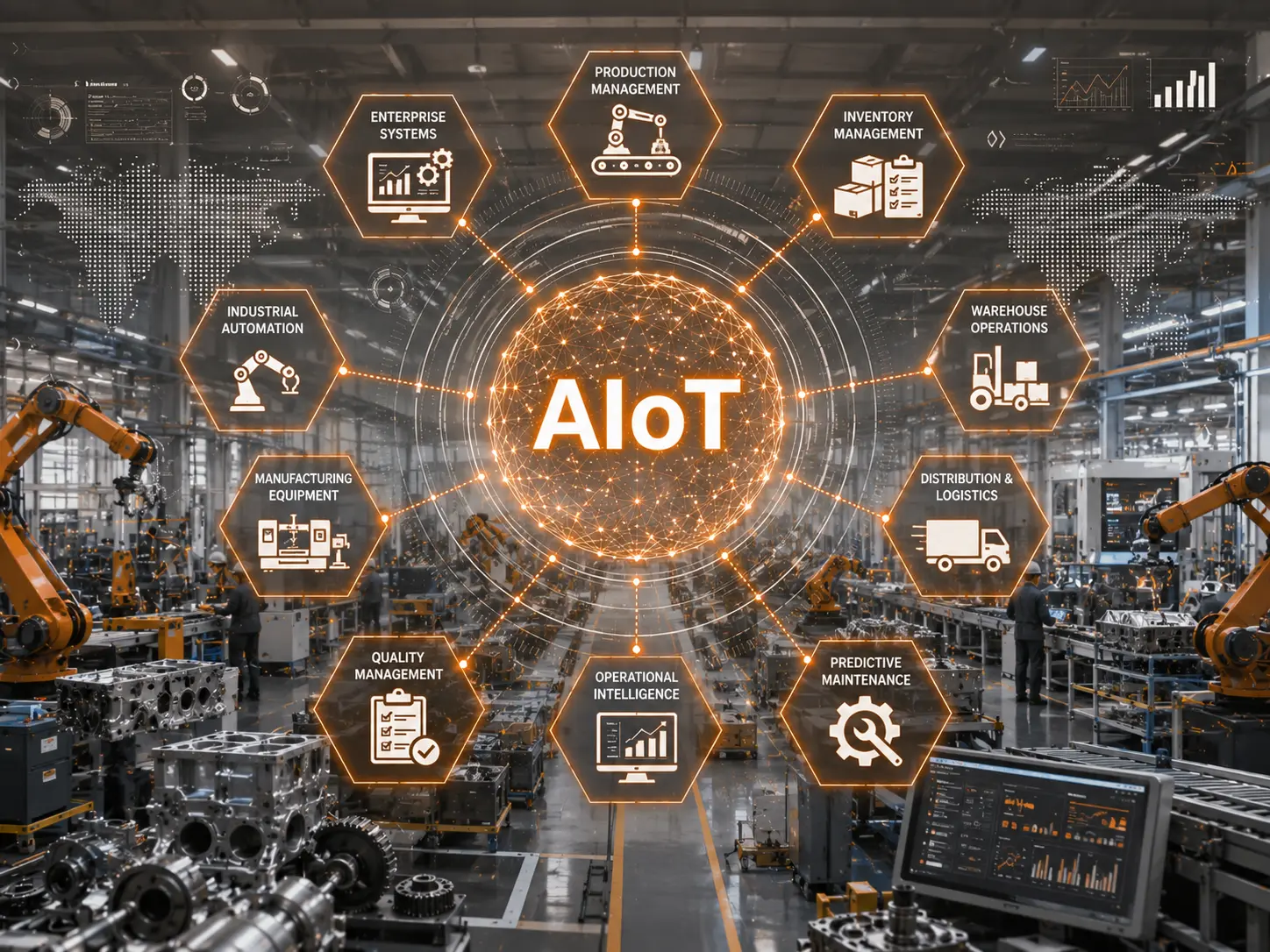
Partsentra AI helps aftermarket parts manufacturers implement connected manufacturing systems that integrate enterprise resource planning (ERP), manufacturing execution systems (MES), warehouse management systems (WMS), programmable logic controllers (PLC), industrial IoT gateways, RFID systems, BLE location technologies, industrial sensors, machine vision systems, and AI analytics systems.
The integrated system enables automotive aftermarket manufacturers to improve replacement parts production visibility, inventory accuracy, production scheduling, equipment utilization, quality control, traceability, and multi-plant manufacturing coordination.
AIoT-enabled manufacturing integration supports applications across:
- Automotive replacement parts machining operations
- Aftermarket component assembly lines
- Injection molded service parts production
- Metal stamping and fabrication processes
- Spare parts warehouse operations
- Parts kitting and packaging workflows
- Supplier receiving and material management
- Warranty return analysis and quality improvement
- Automotive aftermarket distribution centers
By connecting operational technology (OT) systems with information technology (IT) systems, manufacturers can transform disconnected production environments into intelligent, data-driven automotive aftermarket manufacturing systems.
AIoT Integration system for Automotive Aftermarket Parts Manufacturing
AIoT integration system enables automotive aftermarket parts manufacturers to establish a connected digital infrastructure where machines, inventory systems, production applications, and enterprise systems exchange real-time operational data.
Unlike traditional manufacturing environments where ERP systems, production equipment, warehouse applications, and quality systems operate independently, AIoT-enabled systems create a unified information flow across the complete aftermarket manufacturing lifecycle.
A modern automotive aftermarket manufacturing integration system typically includes multiple technology layers:
- Enterprise application layer connecting ERP, MES, WMS, QMS, PLM, and supply chain systems
- Manufacturing operations layer managing production scheduling, work orders, quality processes, and shop floor execution
- Industrial connectivity layer integrating PLC systems, industrial Ethernet networks, field devices, and machine controllers
- IoT data acquisition layer collecting information from RFID readers, BLE tags, industrial sensors, machine vision systems, and smart devices
- Edge computing layer processing manufacturing data locally for real-time analytics and operational decisions
- Cloud and analytics layer supporting AI models, production intelligence, predictive analytics, and multi-site visibility
This layered system supports automotive aftermarket production environments where manufacturers must manage thousands of replacement parts, multiple production processes, supplier networks, and changing service demand requirements.
Industrial IoT gateways act as a critical connection point between manufacturing equipment and enterprise systems. These gateways collect machine data from CNC machining centers, injection molding equipment, stamping presses, assembly stations, inspection equipment, and automated material handling systems.
Common industrial communication technologies include:
AIoT systems also support hybrid deployment models combining cloud systems, private servers, and factory edge computing environments. This flexibility allows automotive aftermarket manufacturers to maintain local production reliability while gaining enterprise-level visibility across multiple facilities.
Enterprise System Connectivity for Automotive Replacement Parts Operations
Enterprise system connectivity enables automotive aftermarket parts manufacturers to synchronize business planning, production execution, inventory management, quality control, and distribution activities.
ERP MES integration is one of the most important foundations for connected aftermarket manufacturing operations. ERP systems manage business processes such as demand planning, purchasing, supplier management, financial control, and material requirements planning. MES systems connect these business requirements with actual manufacturing activities on the factory floor.
Integrated ERP and MES environments provide:
- Real-time production order synchronization
- Automated material requirement updates
- Manufacturing schedule optimization
- Shop floor production visibility
- Quality data integration
- Production performance analytics
- Traceability from raw material to finished replacement part
For aftermarket parts manufacturers, ERP MES integration is especially valuable because replacement component production often requires flexible scheduling based on service demand, inventory conditions, warranty requirements, and regional market needs.
Warehouse management system integration extends visibility into aftermarket spare parts inventory operations. Connected WMS systems coordinate raw materials, work-in-progress inventory, finished replacement parts, and distribution activities.
AIoT-enabled warehouse integration supports:
- RFID-based spare parts identification
- Automated inventory movement tracking
- Smart bin monitoring
- Warehouse location intelligence
- Parts replenishment optimization
- Distribution center visibility
RFID systems combined with AI analytics can provide real-time visibility into replacement parts movement throughout manufacturing facilities and warehouses. Industrial RFID readers, RFID dock door portals, RFID labels, and automated identification systems reduce manual tracking activities while improving inventory accuracy.
BLE location systems provide additional visibility for mobile assets, production tooling, returnable containers, and manufacturing equipment. BLE beacons, tags, anchors, and IoT gateways enable manufacturers to understand asset movement patterns and optimize material flow.
Industrial API Integration for Connected Aftermarket Manufacturing Systems
Industrial API integration enables automotive aftermarket parts manufacturers to connect diverse software systems, manufacturing equipment, and industrial data sources into a coordinated digital environment.
Many aftermarket manufacturing facilities operate with a combination of modern enterprise applications and legacy industrial equipment. API-based integration allows organizations to connect existing technologies without requiring complete replacement of operational systems.
Industrial API integration supports communication between:
- ERP systems and MES applications
- MES systems and PLC-connected production equipment
- WMS systems and inventory tracking systems
- Quality management systems and production databases
- IoT systems and AI analytics engines
- Supplier systems and manufacturing workflows
A connected API framework creates a continuous data exchange environment where operational events can automatically trigger business and manufacturing actions.
Examples include:
- A completed machining operation automatically updating MES production status
- Finished replacement parts updating ERP inventory records
- Quality inspection results being linked to specific production batches
- RFID tracking events updating warehouse inventory locations
- Machine condition alerts creating maintenance workflows
Industrial API integration also supports manufacturing data interoperability across multiple production facilities. Automotive aftermarket manufacturers operating multiple plants can standardize data exchange models, improve operational visibility, and compare production performance across locations.
A strong integration system helps organizations avoid isolated technology deployments by creating a connected manufacturing system where systems work together through structured data communication.
Manufacturing Data Orchestration and Synchronization for Aftermarket Parts Production
Manufacturing data orchestration enables automotive aftermarket manufacturers to collect, normalize, process, and distribute operational information across connected production environments.
Modern aftermarket parts facilities generate large volumes of industrial data from:
- CNC machines
- Injection molding systems
- Stamping equipment
- Assembly stations
- Inspection systems
- RFID infrastructure
- BLE location networks
- Environmental sensors
- Energy monitoring devices
Without proper data orchestration, valuable production information remains fragmented across separate systems. AIoT integration creates a unified data environment where manufacturing information can support operational decision-making.
Industrial data orchestration capabilities include:
- Real-time IoT data integration
- Manufacturing event stream processing
- Production data synchronization
- Equipment data aggregation
- Cross-system workflow automation
- AI-ready data pipeline development
Manufacturing event processing allows systems to respond automatically to operational changes.
Examples include:
- A replacement part entering a machining workstation
- A production batch completing inspection
- A tooling asset moving to another production area
- A machine sensor detecting abnormal operating conditions
- A warehouse system receiving finished inventory
These events can trigger automated workflows across ERP, MES, WMS, and analytics systems.
For automotive aftermarket parts manufacturers, synchronized manufacturing data improves production planning, inventory control, quality management, and traceability. It creates a foundation for AI-driven applications such as production bottleneck prediction, demand-based scheduling, predictive maintenance, and manufacturing performance optimization.
Digital Manufacturing Process Coordination for Automotive Aftermarket Parts Production
Digital manufacturing process coordination enables automotive aftermarket parts manufacturers to synchronize production activities across machining, molding, stamping, assembly, inspection, packaging, and warehouse operations. AIoT integration connects production workflows with real-time operational intelligence, allowing manufacturers to respond faster to changing service parts demand, production constraints, and quality requirements.
Automotive aftermarket manufacturing environments often involve high-mix, variable-volume production because replacement parts must support diverse vehicle systems, model years, regional requirements, and service lifecycle needs. Connected manufacturing systems help manage this complexity by linking production planning, material availability, equipment conditions, and quality information.
AIoT-enabled digital manufacturing coordination supports:
- Automated work order synchronization between ERP and MES systems
- Real-time production status monitoring across manufacturing cells
- Digital work instructions for aftermarket component assembly
- Production sequence optimization based on operational conditions
- Automated quality data collection and verification
- Manufacturing exception detection and workflow management
- Production performance analytics across multiple facilities
MES systems provide the operational foundation for coordinating aftermarket parts production. When MES systems are integrated with PLC-connected equipment, industrial sensors, RFID systems, and machine vision technologies, manufacturers gain visibility into production cycle times, equipment availability, process parameters, material consumption, and quality results.
For example, a CNC machining facility producing replacement automotive components can collect machine utilization data, tool wear information, spindle conditions, production cycle times, and inspection measurements. AI analytics can evaluate this information to identify process inefficiencies, predict equipment performance issues, and improve production scheduling.
Connected production coordination also supports flexible manufacturing strategies where aftermarket manufacturers need to quickly adjust production priorities based on:
- Service parts demand changes
- Warranty replacement requirements
- Inventory shortages
- Supplier material availability
- Production capacity constraints
- Customer fulfillment requirements
Digital manufacturing workflows reduce dependence on manual information exchange and create a more transparent production environment where decisions are based on current operational data.
Edge Intelligence for Automotive Aftermarket Manufacturing
Edge computing for manufacturing provides localized processing capabilities by analyzing industrial data near production equipment rather than sending all information to centralized cloud systems. For automotive aftermarket parts manufacturing, edge intelligence enables faster response times, improved reliability, and real-time operational decision-making.
Factory edge computing systems collect and analyze information from:
- CNC machining equipment
- Injection molding machines
- Metal forming systems
- Assembly stations
- Industrial robots
- Machine vision cameras
- RFID readers
- BLE location systems
- Environmental monitoring sensors
Edge AI for aftermarket parts manufacturing supports applications requiring immediate processing, including quality inspection, equipment monitoring, production anomaly detection, and manufacturing process control.
Key edge intelligence applications include:
- Real-time machine condition monitoring
- AI-based visual inspection of replacement components
- Local production anomaly detection
- Equipment performance analytics
- Manufacturing process optimization
- Industrial network monitoring
- Automated production alerts
AI vision systems operating at the factory edge can inspect aftermarket components for dimensional accuracy, surface defects, assembly errors, incorrect labeling, and packaging issues. Edge-based image processing reduces latency by analyzing inspection data locally while transferring only relevant results to enterprise systems.
Machine health monitoring is another important edge application. Industrial vibration sensors, temperature sensors, current monitoring devices, and machine controllers can provide continuous equipment condition data. AI algorithms running on edge systems can detect abnormal patterns that may indicate tool degradation, machine wear, or process instability.
Edge computing also improves manufacturing resilience by maintaining critical analytics and automation capabilities even when external network connectivity is limited. Production facilities can continue operating while synchronizing collected information with enterprise systems when communication becomes available.
AI-Driven Manufacturing Analytics Integration
AI-driven manufacturing analytics integration converts industrial data from connected aftermarket parts facilities into actionable intelligence for production optimization, quality improvement, inventory planning, and operational decision-making.
AI models analyze information collected from:
- ERP production planning systems
- MES manufacturing execution systems
- WMS inventory systems
- PLC-connected machinery
- RFID tracking systems
- BLE asset monitoring networks
- Industrial IoT sensors
- Machine vision inspection systems
- Quality management databases
AI-powered analytics applications for automotive aftermarket parts manufacturing include:
- Production bottleneck prediction
- Manufacturing cycle optimization
- Equipment utilization analytics
- Quality exception prediction
- Parts demand forecasting integration
- Supplier performance analysis
- Inventory optimization intelligence
- Warranty failure analytics
Production bottleneck prediction uses historical and real-time manufacturing data to identify potential production delays before they affect delivery schedules. AI models can evaluate machine availability, production queues, tooling conditions, material availability, and operator workflows.
Manufacturing cycle optimization helps identify opportunities to improve throughput by analyzing production timing, equipment utilization, process variations, and workflow dependencies.
Quality analytics integration enables manufacturers to connect inspection results with production history, supplier information, material data, and equipment conditions. This creates a comprehensive quality intelligence framework for identifying root causes of defects and improving replacement part reliability.
AI-driven inventory analytics also supports aftermarket parts operations by connecting production capability with service demand patterns. Manufacturers can improve stocking strategies by analyzing historical demand, production lead times, inventory levels, and regional distribution requirements.
AIoT Applications Across Automotive Aftermarket Parts Manufacturing
AIoT integration supports a broad range of automotive aftermarket parts manufacturing applications by connecting physical operations with intelligent software systems.
Spare Parts Warehouse Operations
Connected warehouse environments combine RFID, BLE, WMS software, IoT sensors, and AI analytics to improve replacement parts storage and distribution.
Applications include:
- RFID-based inventory tracking
- Automated parts location management
- Smart bin monitoring for service components
- Warehouse workflow optimization
- Inventory accuracy improvement
- Multi-warehouse visibility
Aftermarket Parts Kitting Operations
AIoT-enabled kitting systems improve assembly preparation by connecting inventory availability, production schedules, and material movement.
Capabilities include:
- Automated kit verification
- RFID-based component confirmation
- Digital assembly instructions
- Material shortage alerts
- Production readiness analysis
CNC Machining for Replacement Components
Connected machining operations use IoT sensors, PLC integration, and edge analytics to improve precision manufacturing performance.
Applications include:
- Machine utilization monitoring
- Tool wear analytics
- Production cycle tracking
- Predictive maintenance support
- Automated process monitoring
Injection Molding for Automotive Service Parts
AIoT technologies support connected injection molding operations by monitoring production parameters and equipment performance.
Capabilities include:
- Mold condition monitoring
- Process parameter tracking
- Quality deviation detection
- Energy consumption analysis
- Production consistency improvement
Aftermarket Parts Traceability and Quality Management
Connected traceability systems link replacement parts with manufacturing history, supplier information, inspection results, and production records.
Applications include:
- Parts serialization management
- Batch genealogy tracking
- Supplier quality monitoring
- Warranty analysis
- Recall impact assessment
Partsentra AI Expertise in AIoT Manufacturing Integration
Partsentra AI provides AIoT integration solutions designed for automotive aftermarket parts manufacturing environments. The system approach combines industrial IoT experience, manufacturing system integration expertise, and practical deployment knowledge to support connected production operations.
Partsentra AI is created within Aperture Venture Studio, with support from GAO. Serving for two decades in IoT, the organization has supported thousands of IoT customers and successfully executed thousands of IoT projects across automotive aftermarket parts manufacturing applications.
The solution foundation is based on engineering experience from GAO, supported by continuous research and development investment, structured quality assurance processes, and expert technical support delivered remotely or onsite.
The team includes Ph.D. professionals from leading universities and has supported Fortune 500 companies, research organizations, universities, and government agencies with IoT and industrial technology solutions.
Partsentra AI helps aftermarket parts manufacturers integrate:
- ERP, MES, WMS, and QMS systems
- PLC-connected manufacturing equipment
- RFID and BLE identification systems
- LoRaWAN and cellular IoT networks
- Industrial IoT gateways
- Edge computing systems
- AI manufacturing analytics systems
These connected systems help manufacturers establish scalable digital infrastructures for production visibility, inventory intelligence, traceability, quality improvement, and operational optimization.
Building the Foundation for Smart Aftermarket Manufacturing
AIoT manufacturing integration provides the foundation for connected automotive aftermarket parts manufacturing by linking enterprise applications, production equipment, warehouse systems, and industrial data systems.
A flexible system combining cloud systems, private servers, edge computing, middleware, industrial communication networks, and enterprise connectivity enables manufacturers to transform distributed manufacturing data into practical intelligence.
By integrating ERP systems, MES systems, WMS solutions, PLC-connected equipment, RFID systems, BLE location technologies, LoRaWAN sensors, industrial IoT gateways, machine vision systems, and AI analytics systems, aftermarket parts manufacturers can create scalable smart factory infrastructures.
These connected systems support production coordination, spare parts inventory optimization, equipment intelligence, quality management, traceability, and AI-driven manufacturing improvement. AIoT integration enables automotive aftermarket manufacturers to move from isolated production processes toward intelligent, connected manufacturing systems capable of supporting evolving service parts requirements and long-term operational efficiency.
Contact Partsentra AI
Connected Enterprise system Linking Automotive Replacement Parts Manufacturing Systems, Industrial Data, and Smart Factory Operations
Submit an Inquiry